Sensory Seeking Preschooler
When our foster son first came to us, we noticed early on that his body often seemed to be “vibrating” at a frequency that made quiet indoor activities feel impossible. When he was unregulated, he didn’t just move. He collided with life! Out of desperation and with advice of an OT we began experimenting with what professionals call “heavy work.”
Playful Heavy Work
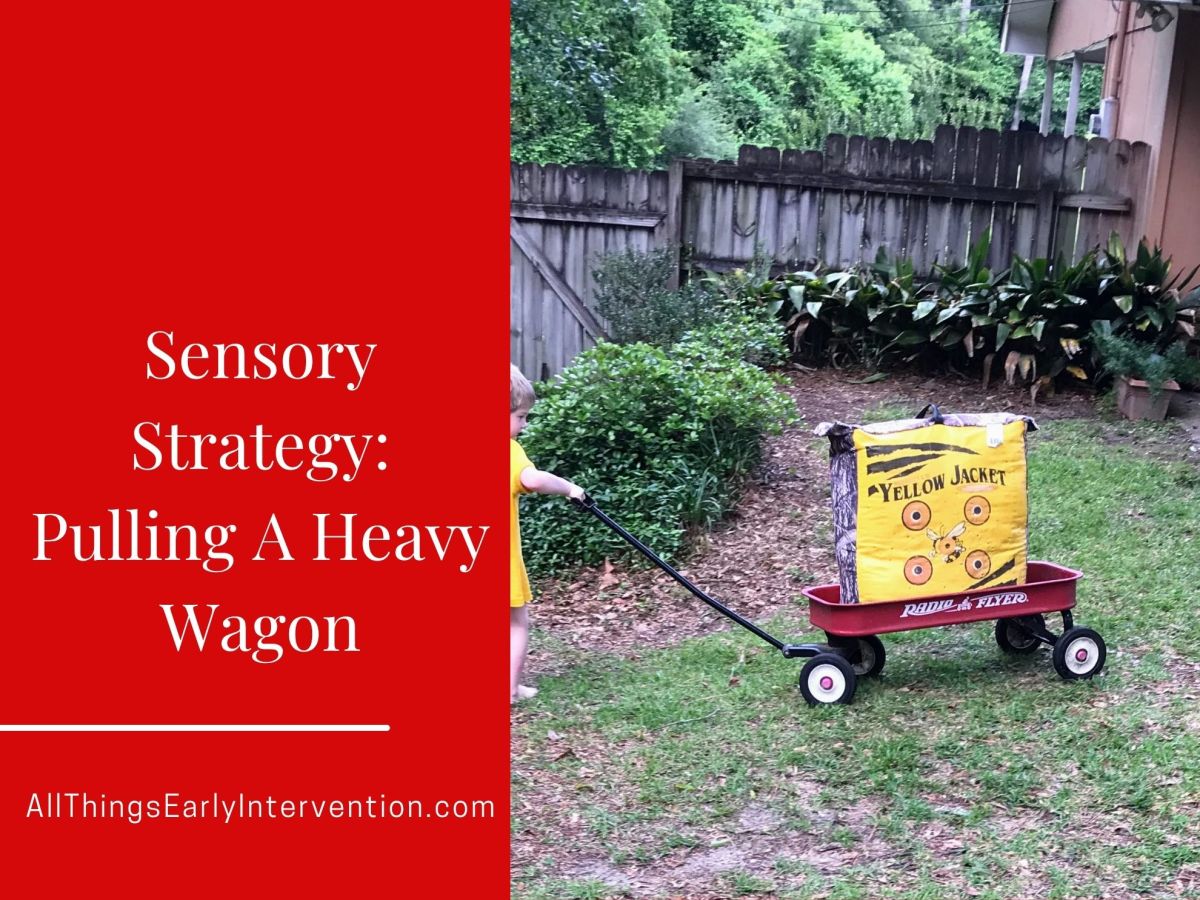
There were lots of things we tried. We had a classic radio flyer wagon, but it was too light to offer much resistance by itself, so we looked for something to weigh it down. Because we have big kids that live in this house too you never know what you’ll find laying around. At this time our oldest was into archery. We gad an archery target for him to practice. It was a perfect fit for the wagon and weighed a ton.
The first time we showed him the “heavy wagon,” he was skeptical. We offered a lot of gentle encouragement just to get him to grab the handle, while keeping our language soft and our praise high. After he pulled it across the yard just once, something shifted. We could almost see his “little brain” processing the positive input. By the third or fourth trip, he was no longer waiting for us to ask. He was seeking out the wagon on his own. Pulling that massive weight seemed to wear out the “chaos” in his system, leaving him noticeably more calm and agreeable afterward.
The Science of Heavy Work
What we were witnessing was the affect of heavy work on his the proprioceptive system. Proprioception is a person’s “position sense,” which is the stream of input from our muscles, joints, and tendons that tells our brain where our body is in space. “Heavy work” as any activity that moves the body against significant resistance. This input is calming and organizing for the central nervous system because it helps the brain “dampen” over-arousal and strengthens internal body awareness.
For children who struggle with regulation, their internal map of their physical state can feel “disjointed” or “scattered.” Pushing or pulling heavy objects provides the clear, strong feedback their joints and muscles crave, which can help “reset” the nervous system.
This is why resistance-based activities, like our heavy wagon, are often recommended as a primary strategy for children who show sensory-seeking behaviors.
Why Pulling the Heavy Wagon Works
Pulling a heavy load is one of the most effective ways to provide proprioceptive “feedback .” It engages the core, upper body, and lower body all at once that can ground a child’s nervous system.
When a child is unregulated, they are often in a sympathetic (stressed) state. Heavy resistance work can help shift the nervous system toward a calmer, more focused state, which is a prerequisite for learning and social engagement. By turning “work” into a functional part of backyard play, we gave him a way to regulate his own energy without it feeling like a “therapy session.”
More Playful Heavy Work Ideas
If you work with young children who seem to be “crashing and bashing” through their day, they may be seeking the same kind of regulation our son found in his wagon. Here are a few other ways to integrate pushing and pulling into a child’s routine:
- Functional Pushing: Encourage children to push a weighted laundry basket, a child-sized shopping cart, or help “move” dining chairs to clean the floor.
- Wall Pushes: For a quick indoor reset, have the child do “wall push-ups” or try to “push the wall down” with their hands and feet.
- Animal Walks: Try “bear crawls,” “crab walks,” or “wheelbarrow walks” to provide intense input to the joints through body weight.
- Carrying Tasks: Invite them to be the “big helper” by carrying a stack of heavy books to the shelf or helping carry a bag of groceries into the house.
- Tug-of-War: Use a sturdy rope or resistance band for a supervised game of tug-of-war to provide upper body resistance.
Stop seeing “difficult” behavior as a choice, and start seeing it as a need for input. The next time a child seems “out of their skin,” look for a way to give their muscles some work to do. Whether it is a heavy wagon or a stack of books, that resistance might be exactly what they need to find their balance again.
References
Beck, C. (2025, July 7). Heavy work activities. The OT Toolbox. https://www.theottoolbox.com/heavy-work-activities/
This resource provided many of the practical suggestions, specifically the use of wall push-ups and therapy bands to provide resistance for a quick sensory reset indoors.
Blanche, E. I., Reinoso, G., Chang, M. C., & Bodison, S. (2012). Proprioceptive processing difficulties among children with autism spectrum disorders and developmental disabilities. The American Journal of Occupational Therapy, 66(5), 621–624. https://doi.org/10.5014/ajot.2012.004234
This study compared chil dren with Autism Spectrum Disorder (ASD) to those with other developmental disabilities. Findings showed that children with ASD have distinct difficulties with feedback-related motor planning, tiptoeing, pushing others, and crashing/falling/running, suggesting these sensory issues contribute to disruptive behaviors and motor planning challenges.
Bueche, L. (2017, September 5). My child needs deep pressure! What do I do? Easterseals DuPage & Fox Valley Blog. https://eastersealsdfvr.wordpress.com/2017/09/05/my-kiddo-needs-deep-pressure-what-do-i-do/
This blog post served as a source for the various animal walks (bear crawls, crab walks, wheelbarrow walks) recommended as alternative ways to provide joint input as well as a variety of practical strategies for providing your child with deep pressure feedback.
Heffron, C. (2015, August 18). 10 calming sensory strategies for school. The Inspired Treehouse. https://theinspiredtreehouse.com/10-calming-sensory-strategies-for-school/
This resource details ten practical strategies for classroom regulation, focusing on environmental modifications and physical sensory input. It highlights the use of quiet retreat spaces, “heavy work” (such as pushing chairs or carrying books), and rhythmic movement to provide calming proprioceptive and vestibular feedback.
Murphy, L. (2018, June 22). How to tame your sensory seeker. NAPA Center. https://napacenter.org/how-to-tame-your-sensory-seeker/.
This source explicitly lists pulling a wagon as a functional work activity to help organize children who are constantly seeking movement. It also provided clear definitions of the proprioceptive and vestibular systems.
Sutapa, P., Pratama, K. W., Rosly, M. M., Syed Ali, S. K., & Karakauki, M. (2021). Improving motor skills in early childhood through goal-oriented play activity. PMC. https://pmc.ncbi.nlm.nih.gov/articles/PMC8625902/.
This research supported the blog’s main point by framing the use of the wagon as a “goal-oriented play activity,” which is shown to be more effective than unstructured movement for engaging the brain and repeating activities for sensory benefit
Some Related Products on Amazon
As an Amazon Associate, I earn on qualifying purchases.