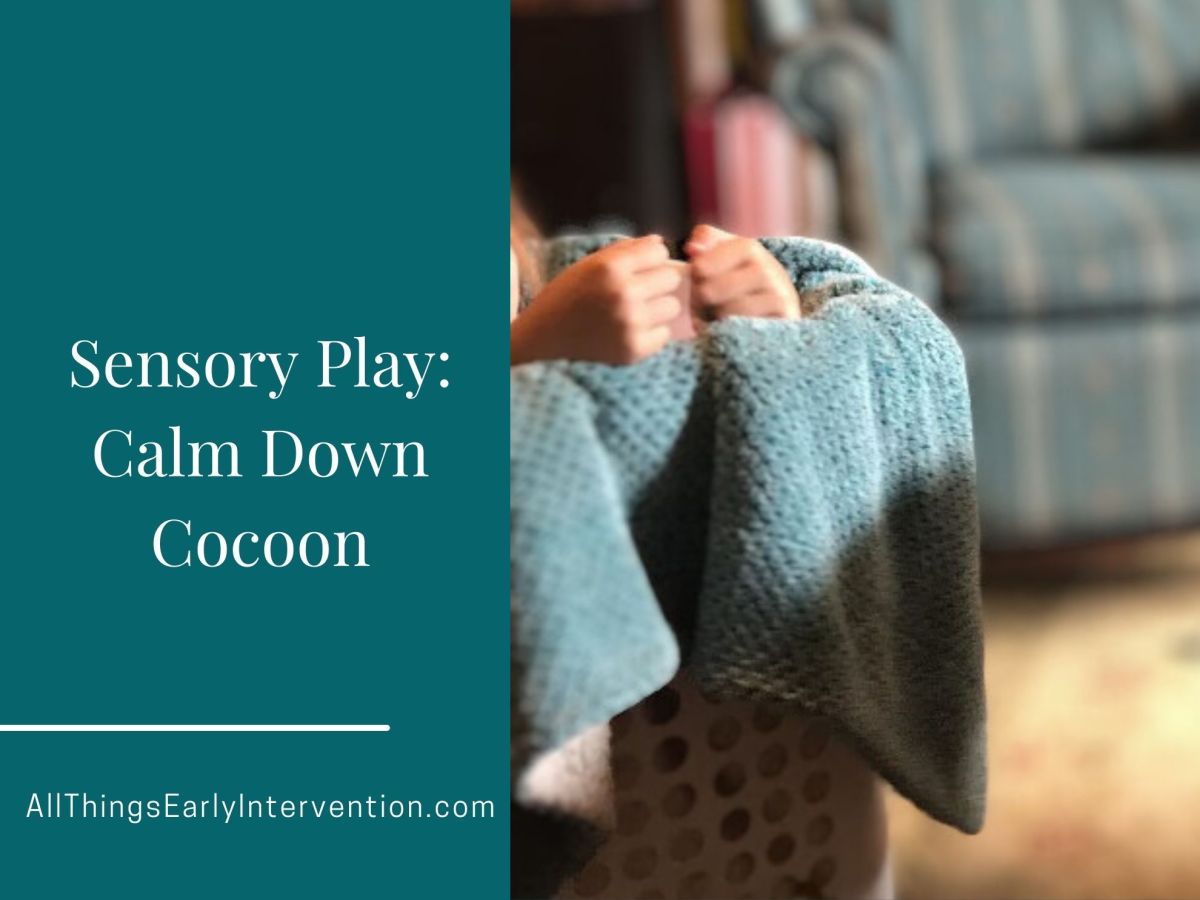
Finding ways to help our sensory-seeking 4-year-old regulate his high energy and big emotions was a daily puzzle. One afternoon in the living room, I was searching for ways to keep him busy and calm. I had been told by his therapist that weighted blankets and other forms of deep pressure could be a helpful tool, but I didn’t have any stuff like they had in the therapy room. I improvised by taking a heavy quilt and folding it several times to create some weight, then laying it over him as he lay on the floor to see what would happen.
He was immediately intrigued by the sensation. He took the idea and ran with it. Literally. He took the quilt, wrapped it around himself and ran around the house and climbed on the furniture.
A few minutes later, I noticed him climbing into an empty laundry basket we had nearby. He still had the quilt wrapped around him. He looked so cozy, so I added another blanket and pillow while he was tucked inside.
We both laughed, and because he was such a fan of The Very Hungry Caterpillar, I told him he looked like he was in a cozy cocoon. He absolutely loved the idea and repeating the word “cocoon.” From that day on, he would often climb into the basket and ask us to help him make a “cocoon.” This sweet, simple invention became a staple in our house, which we eventually dubbed the “Calm Down Cocoon.”
The Science of the Squish
What looked like a simple game of pretend was actually a powerful way of providing deep touch pressure, which is a type of firm sensory input that has a relaxing and calming effect on the nervous system.
Occupational therapists have long observed that while light touch can be alerting, deep pressure—like that provided by a firm hug or a heavy blanket—helps to organize the central nervous system. This type of input can be especially beneficial for children who are sensory seekers, as they often require more intense input to feel regulated.
Combining this pressure with an enclosed space adds another layer of benefit. For children who struggle with body awareness or proprioception—the sense of where their body is in space—a small, contained area like a laundry basket or a box provides clear physical boundaries. This “mini-sensory room” helps the brain process where the body ends and the rest of the world begins, which can significantly lower a child’s state of arousal and reduce anxiety.
Why the Cocoon Worked for Us
The Calm Down Cocoon was a perfect solution for us because it provided a full-body calming sensory experience that was both safe and contained. It allowed his entire body to feel the “squish” of the quilt against the rigid sides of the basket, providing the proprioceptive feedback he needed to feel grounded while staying busy and calm inside the house.
Creating Your Own Sensory Retreats
If you work with young children who struggle to find a sense of calm indoors, you can easily create these types of supports using items already in your environment:
- The DIY Squish Box: Use a large cardboard box filled with soft blankets and pillows to create a quiet retreat where a child can feel “held” by the environment.
- The “Kiddo Burrito”: Take a yoga mat or a heavy blanket and gently roll the child up (keeping their head clearly visible) to provide deep, even pressure across the whole body.
- DIY Crash Pad: Fill a large duvet cover with pillows or foam scraps to create a dedicated space where children can safely “crash” and get the intense proprioceptive input they need.
- Weighted Items: If you don’t have a weighted blanket, a heavy quilt or even a “weighted” stuffed animal can provide localized deep pressure.
The next time a child is struggling to regulate, look for the “squish.” Providing a contained, high-pressure space—whether it’s a laundry basket or a blanket roll—might be the “cocoon” they need to find their calm again.
Just remember that these tools are most effective when used for short intervals (about 15-20 minutes) and under close supervision to ensure the child stays safe and doesn’t become overheated.
References
Bestbier, L., & Williams, T. I. (2017). The immediate effects of deep pressure on young people with autism and severe intellectual difficulties: Demonstrating individual differences. Occupational Therapy International. https://doi.org/10.1155/2017/7534972
This study provided evidence for the immediate calming effects of deep pressure on children with sensory needs. It specifically noted children trying to get into very small spaces.
Grandin, T. (1992). Calming effects of deep touch pressure in patients with autistic disorder, college students, and animals. Journal of Child and Adolescent Psychopharmacology. https://doi.org/10.1089/cap.1992.2.63
This article distinguishes between light touch (alerting) and deep touch pressure (calming). It also detailed how contained spaces enhance the feeling of being “surrounded and contained”.
Heffron, C. (2015, August 18). 10 calming sensory strategies for school. The Inspired Treehouse. https://theinspiredtreehouse.com/10-calming-sensory-strategies-for-school/
This resource defines how weighted blankets and “squishes” with pillows provide full-body calming sensory input. It also offered the idea of using “quiet spaces”—like small tents or corners with pillows—to help a child regroup.
Kansas Children’s Discovery Center. (Accessed April 26, 2026). Squish box: Discovery at home. https://kansasdiscovery.org/squish-box-discovery-at-home/
This blog provided instructions for the Squish Box using a large box, pillows, and a heavy blanket to create a personally designed mini sensory room for a toddler to practice self-regulation.
Murphy, L. (2018, June 22). How to tame your sensory seeker. NAPA Center. https://napacenter.org/how-to-tame-your-sensory-seeker/
This source provides a tutorial for a DIY sensory crash pad using big pillows for whole-body sensory input.
Bueche, L. (2017, September 5). My child needs deep pressure! What do I do? Easterseals DuPage & Fox Valley Blog. https://eastersealsdfvr.wordpress.com/2017/09/05/my-child-needs-deep-pressure-what-do-i-do/
This source shares the idea of wrapping a child tightly (not to tightly) in a blanket and Sandwich games to squish a kiddo between two pillows.
A Sensory Life! (Accessed April 25, 2026). Sensory uses for a box! https://asensorylife.com/sensory-uses-for-a-box.html
This resource highlighted the benefit of sitting in a box as a “contained space” for children who lack body awareness. It specifically suggested adding pillows to create a “squish box” to help a child feel grounded.
Some Related Products on Amazon
As an Amazon Associate, I earn on qualifying purchases.