The Slow-Motion Snow Angel: Lessons from a Spinny Chair
When living with our foster son, we realized that every piece of furniture was viewed through his eyes as a piece of playground equipment. I had originally purchased a spinny chair for a very practical reason: it made giving the big boys haircuts much easier. However, once our little one discovered it, the chair’s original purpose was forgotten.
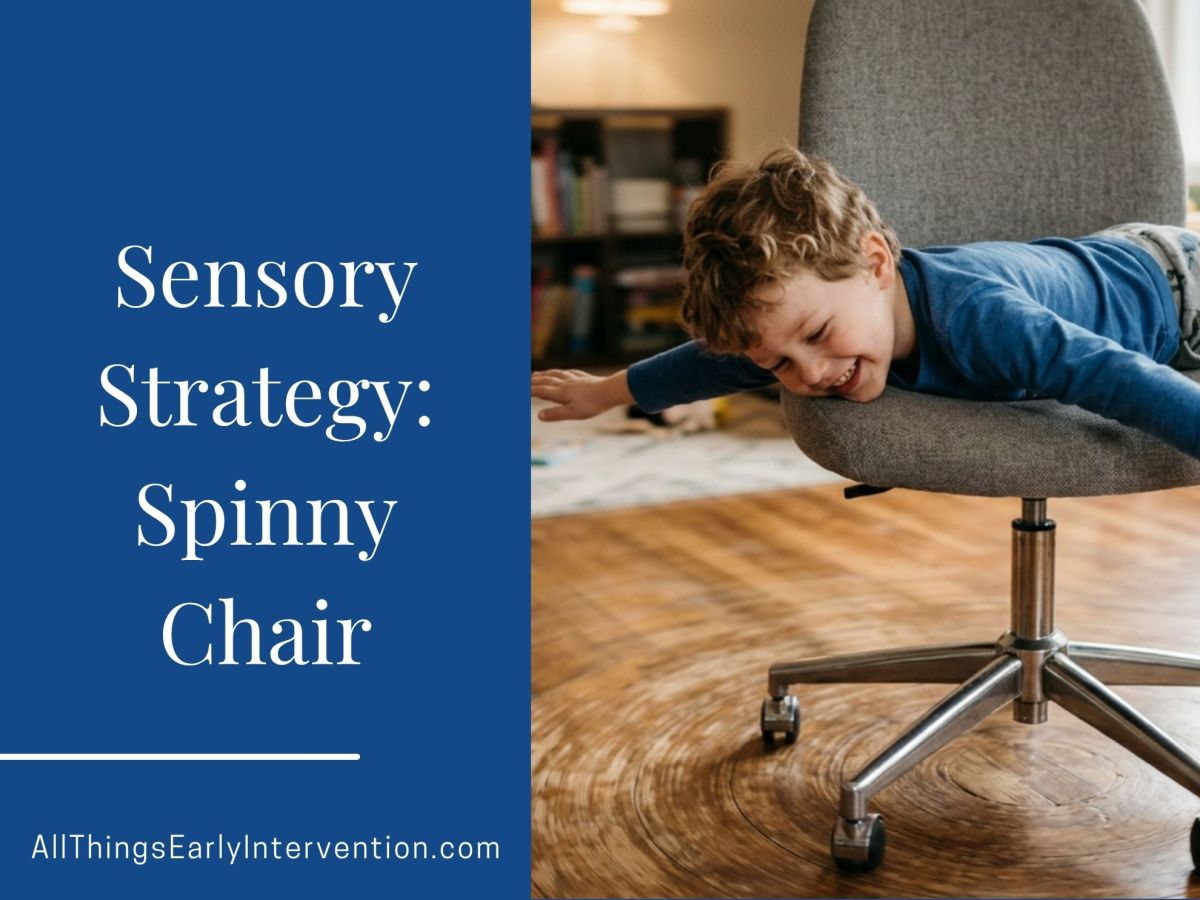
Instead of sitting in it, he would lay across the seat on his tummy. He eventually figured out exactly how much momentum he needed to push off with his toes to start a rotation. He would then lift his arms and legs wide—like he was making a slow-motion snow angel in the air—and spin until the chair came to a natural stop. There was no point in stopping him; it was clear his body was doing exactly what it needed.
The Science of the Spin
This playful activity was his body’s solution for the vestibular input he craved. Vestibular input is a person’s sense of movement and balance. Our vestibular system uses sensors in the ear to send feedback to the brain regarding the direction and speed of our movement at any given time. This system operates continuously in the background, but for children who struggle with regulation, standard movement often isn’t enough to fill their “sensory bucket”.
Spinning movement has a dual effect on the nervous system: rapid or unpredictable acceleration can increase alertness and arousal, while slow, rhythmic movement is calming. Spinning is a powerful tool that requires a “just right” approach. For children identified as “sensory seekers,” unstructured movement can actually lead to more disregulation.
Experts in sensory integration therapy recommend interrupted movement—stopping the spinning to perform a functional task, like throwing a ball, before spinning in the opposite direction—to prevent the child from becoming out of control.
Turning Household Items into Regulation Tools
Allowing him to use the haircut chair as a sensory tool was a calculated risk, but it was one that paid off in the end. While watching him spin with his limbs extended felt a bit like watching a high-wire act, we saw the immediate result: a child who was engaged, entertained, and—most importantly—calm.
This chair became one of many ordinary household items we repurposed for his needs. Much like the “calm down cocoon” made of laundry baskets or the play wagon we weighed down for the yard, the spinny chair provided the specific sensory feedback his brain was starving for. By providing a safe and supervised outlet for his need to move, we were able to calm his nervous system, replacing disorganized energy with focused, quiet play.
Bringing Movement Indoors: Practical Steps
If you work with children who seem to be constantly seeking movement, you don’t always need specialized therapy equipment. You can include vestibular input in daily play using what you have:
- The “Start and Stop” Spin: If you have a swivel chair, let the child spin, but use a timer or a goal-directed task (like “after three spins, stop and high-five me”) to keep them regulated.
- Therapy Ball Rocking: Using a large exercise or therapy ball for gentle back-and-forth or rhythmic movement can provide a calming reset when a child is overwhelmed.
- Rhythmic Swinging: If you have access to a playground, encourage consistent, rhythmic patterns on swings to help organize the vestibular system.
- The “Scooter” Effect: For children who need more linear movement, using a small scooter board for gentle back-and-forth motion can be very organizing. Read about our repurposed skateboard.
Look around your home. Is there something that could serve another purpose, meeting a child’s sensory needs. When we stop seeing these items as just furniture and start seeing them as tools for regulation, we open up a world of calm for the children we serve.
References
Berry, R. (2020, December 22). Sensory seekers. Developmental Pathways for Kids. https://developmentalpathways.com/blog/sensory-seekers/
This source provided the strategy of “interrupted” movement. It explains that while movement can be therapeutic, unstructured spinning can lead a sensory seeker to become out of control.
Heffron, C. (2015, August 18). 10 calming sensory strategies for school. The Inspired Treehouse. https://theinspiredtreehouse.com/10-calming-sensory-strategies-for-school/
This resource was used for the practical tools such as therapy balls for rhythmic movement and scooter boards. It suggests rhythmic vestibular input as an effective way to help a child reset when they are overstimulated.
Lane, S. J., Mailloux, Z., Schoen, S., Bundy, A., May-Benson, T. A., Parham, L. D., Roley, S. S., & Schaaf, R. C. (2019, June 28). Neural foundations of Ayres Sensory Integration. PMC. https://pmc.ncbi.nlm.nih.gov/articles/PMC6680650/
This scientific source explains that rapid acceleration increases alertness and arousal, and slow, rhythmic movement produces the opposite effect, acting as a calming agent for the nervous system. It also details how the vestibular system operates.
Murphy, L. (2018, June 22). How to tame your sensory seeker. NAPA Center. https://napacenter.org/how-to-tame-your-sensory-seeker/
This source provided the definition of the vestibular sense as the ability to sense movement and balance through sensors in the ear. It explains why sensory seekers use behaviors like spinning to give their bodies the feedback their systems crave.
Some Related Products on Amazon
As an Amazon Associate, I earn on qualifying purchases.