
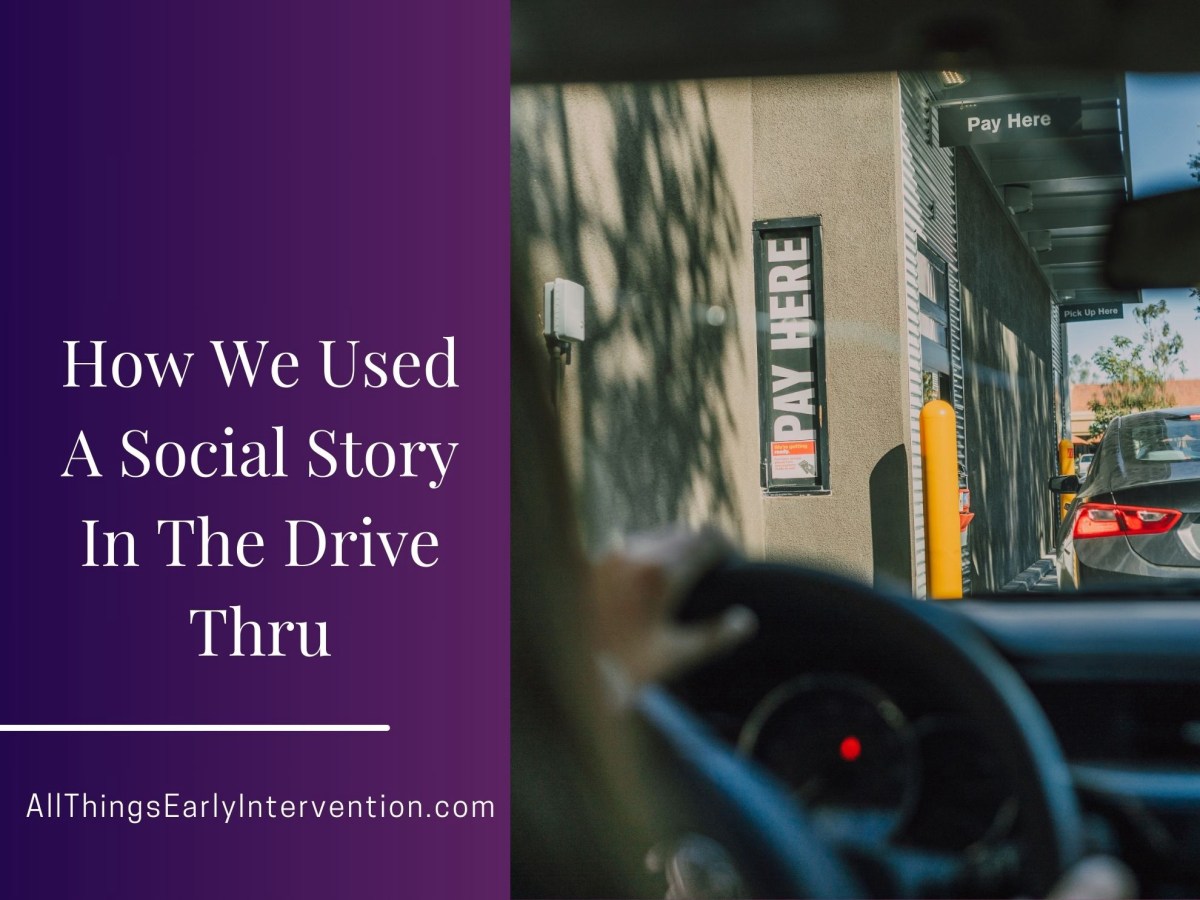
Preventing Drive-Thru Tantrums with Social Stories
Many of us who work with children with special needs have encountered the challenge of navigating everyday situations that can prompt an epic meltdown. For Little Monkey, our foster child, a seemingly simple trip to the drive-thru became a guaranteed meltdown.
The Drive-Thru Dilemma
Little Monkey’s tantrums stemmed from a combination of impatience and confusion. He wanted a cheeseburger, but he didn’t understand the wait time between ordering and receiving food. This uncertainty triggered frustration, and our efforts to calm him down only intensified his emotions.
What Worked In The Past
Over time, I witnessed the positive impact of Daniel Tiger’s songs on Little Monkey’s ability to manage his emotions. I also witnessed the effectiveness of teaching him not to bite, by reading a book about biting. This led me to believe that he could benefit from a customized story about going to McDonalds drive-thru.
What is a Social Story?
“Social Stories are a social learning tool that supports the safe and meaningful exchange of information between parents, professionals, and people with autism of all ages. The people who develop Social Stories are referred to as Authors, and they work on behalf of a child, adolescent, or adult with autism, the Audience.”
Carol Gray Social Stories website, 2024. https://carolgraysocialstories.com/social-stories/what-is-it/ obtained 12/20/24
How to Write A Social Story
Two main types of sentences are used when writing social stories:
- descriptive
- directive
Descriptive sentences:
• State the facts (e.g., “My name is .” Or “The teacher is standing.”)
• Include thoughts and feelings of the student and others in the story (e.g., “The teacher will like it when I listen.” Or “Many people want to learn.”)
• Identify what others can do to help the student if help is needed (e.g., “If I feel upset, my teacher can help by.”)
• Express a shared opinion or reassure the student (e.g., “This is okay.”).
Directive sentences:
• Identify possible responses (e.g., “If I need a break, I can tell the teacher or put the break card on my desk and go to the beanbag.”)
• Gently direct behavior (e.g., I will try to ____.”)
How to write a Social Story from Vanderbilt Kennedy Center Treatment and Research Institute for autism spectrum disorders obtained 12/20/24 https://vkc.vumc.org/assets/files/tipsheets/socialstoriestips.pdf
Crafting a Social Story for the Drive-Thru
Here’s our social story about going through a fast-food drive-thru, written with a preschool child with developmental disability in mind:
Going to the Drive-Thru Story:
Sometimes we go to a fast-food restaurant. We get in the van and drive to the restaurant.
- What happens: We drive slowly up to the speaker.
- How it feels: I might be hard to wait our turn.
- What to do: We can listen to music and look out the window while we wait.
The speaker will turn on.
- What happens: The drive-thru worker will say, “May I take your order?” and we will tell them what we want to eat.
- How it feels: I might be hungry. It might be hard to wait.
- What to do: I can stay in the van, listen to music, look out my window.
We drive slowly forward to the window.
- What happens: We pay for our food.
- How it feels: It might be hard to wait.
- What to do: I can wait patiently for my food and listen to my music and look out the window.
We drive slowly forward to the next window.
- What happens: The worker hands us our food.
- How it feels: I can smell the food. It might be hard to wait.
- What to do: I can wait for my food, listen to my music and look out the window.
We drive away from the drive thru.
- What happens: We eat our food.
- How it feels: I can feel happy. I taste my food.
- What to do: I can enjoy my food!
Success at the Drive-Thru!
While it wasn’t an overnight success, the social story proved to be a game-changer. Equipped with a road map for what to expect, Little Monkey was able to navigate the drive-thru experience with newfound calm.
This success story highlights the power of social stories in equipping children with the tools they need to manage everyday situations.
Additional Resources for Social Stories
The UW READi Lab has partnered with Autism Speaks to provide a series of personalized PowerPoint templates that parents and therapists can use to explain social situations to children with autism. We invite families to customize these story templates with your own photos or pictures to help your child know what to expect and how to act in a variety of everyday situations. The Personalized Story templates currently available are: Going to a Restaurant, Going to the Store, Handling Bullying, Having a Play Date, Potty Training, and Taking Turns.
From Autism Speaks at https://www.autismspeaks.org/templates-personalized-teaching-stories
Conclusion
By working together and using creative tools like social stories, we can empower children with special needs to approach new situations with confidence.
 All Things Early Intervention
2 replies on “How We Used A Social Story To Prevent Drive Thru Meltdowns”
[…] How We Used A Social Story To Overcome The Drive Thru Tantrums […]
LikeLike
[…] and said goodnight to everyone and everything in the house (including the occasional toy). Reading social stories that helped prepare him for bedtime expectations. We incorporated rocking, lullabies, firm back […]
LikeLike