Categories
Early Intervention Activities and Strategies

6 Ways to Play With a Sky Spin

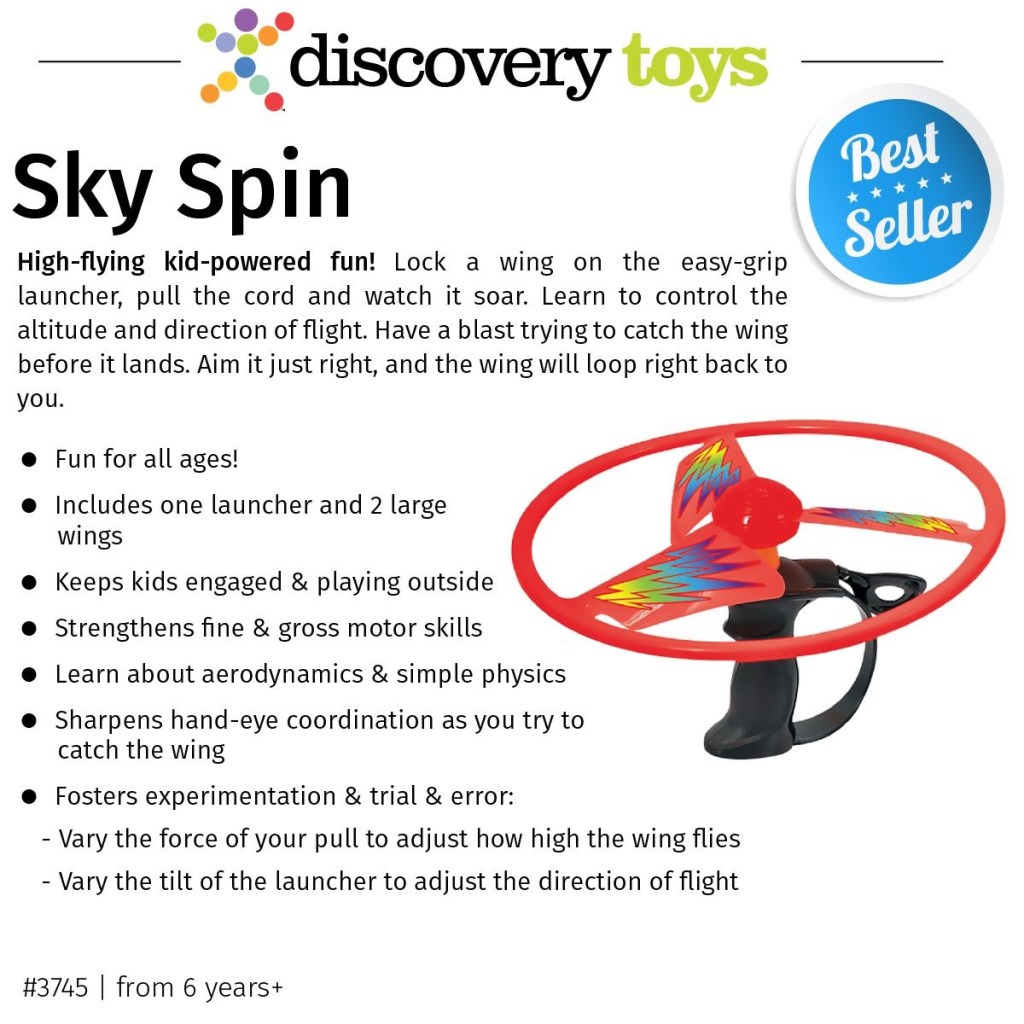
I’m always on the lookout for toys that can spark creativity and learning in young children. One such toy is the Sky Spin. This simple yet engaging toy can be used in a variety of ways to promote developmental skills.

Here are six fun and educational ways to play with a Sky Spin:

I’m always on the lookout for toys that can spark creativity and learning in young children. One such toy is the Sky Spin. This simple yet engaging toy can be used in a variety of ways to promote developmental skills. Young children (toddlers or preschoolers) will have a hard time making this toy work. The following list assumes that the adult is activating the toy for the child.

Here are six fun and educational ways to play with a Sky Spin:

  1. Play Fetch: Toss the Sky Spin and encourage your child to retrieve it. This simple game helps build social interaction, turn-taking, and gross motor skills.
  2. Model Language: As you play, use descriptive language to enhance your child’s vocabulary. Say things like, “Up high!” “Over there!” and “Where is it?”
  3. Encourage Walking: For new walkers, the Sky Spin can be a great motivator. Shoot it across the room and encourage your child to walk to get it…over and over. This helps build balance and coordination.
  4. Practice Repetition: The repetitive nature of the Sky Spin makes it perfect for practicing a variety of skills. Whether you’re working on language, motor skills, or social interaction, repetition is key.
  5. Build Language: Count down before launching the Sky Spin: “3, 2, 1, Weeee!” or “Ready, Set, Go!” This helps build anticipation and excitement.
  6. Teach Pointing: Ask, “Where is it?” and encourage your child to point to the Sky Spin. This helps develop early communication skills.

Remember, the most important thing is to have fun and enjoy the process of learning together. By using simple toys like the Sky Spin, you can create countless opportunities for growth and development.
Simple Tools in Early Intervention: The Mirror

Language starts long before the first word is spoken; it begins with awareness, body movement, and imitation. The mirror is so powerful because it provides immediate visual feedback—a principle supported by speech-language research.

Keep reading

Sensory Play: Stretchy Bands

For a sensory-seeking child who is always looking for movement, if that movement comes in the form of a fun, voluntary activity—like using an elastic band to play with—that is an improvement.

Keep reading

Sensory Play: Bedtime Routine Part 2

Creating a peaceful bedtime routine for a child with sensory processing challenges takes time, patience, and experimentation. By understanding your child’s unique needs and incorporating sensory strategies, you can create a bedtime routine that promotes relaxation and sleep for everyone.

Keep reading

Sensory Play: Jumping on the Indoor Trampoline

Jumping can be a powerful tool in our sensory toolkit. By understanding the science of it and incorporating it thoughtfully, we can help sensory-seeking children find regulation, improve their motor skills, and engage more fully in their world.

Keep reading

Sensory Play: A Calming Aquarium Scene

My experience reminded me that sensory input doesn’t always have to be about high-energy stimulation. Nature scenes, whether real or simulated, can offer a gentle, calming alternative. This aligns with the research, which emphasizes the stress-reducing effects of nature.

Keep reading

Sensory Play: The Body Sock

We tried all sorts of heavy work activities, and one that really stood out was the sensory body sock. It was like magic! He’d climb in, push against the stretchy fabric, and… instant calm. It gave me peace to see his little body find some peace.

Keep reading

Something went wrong. Please refresh the page and/or try again.