
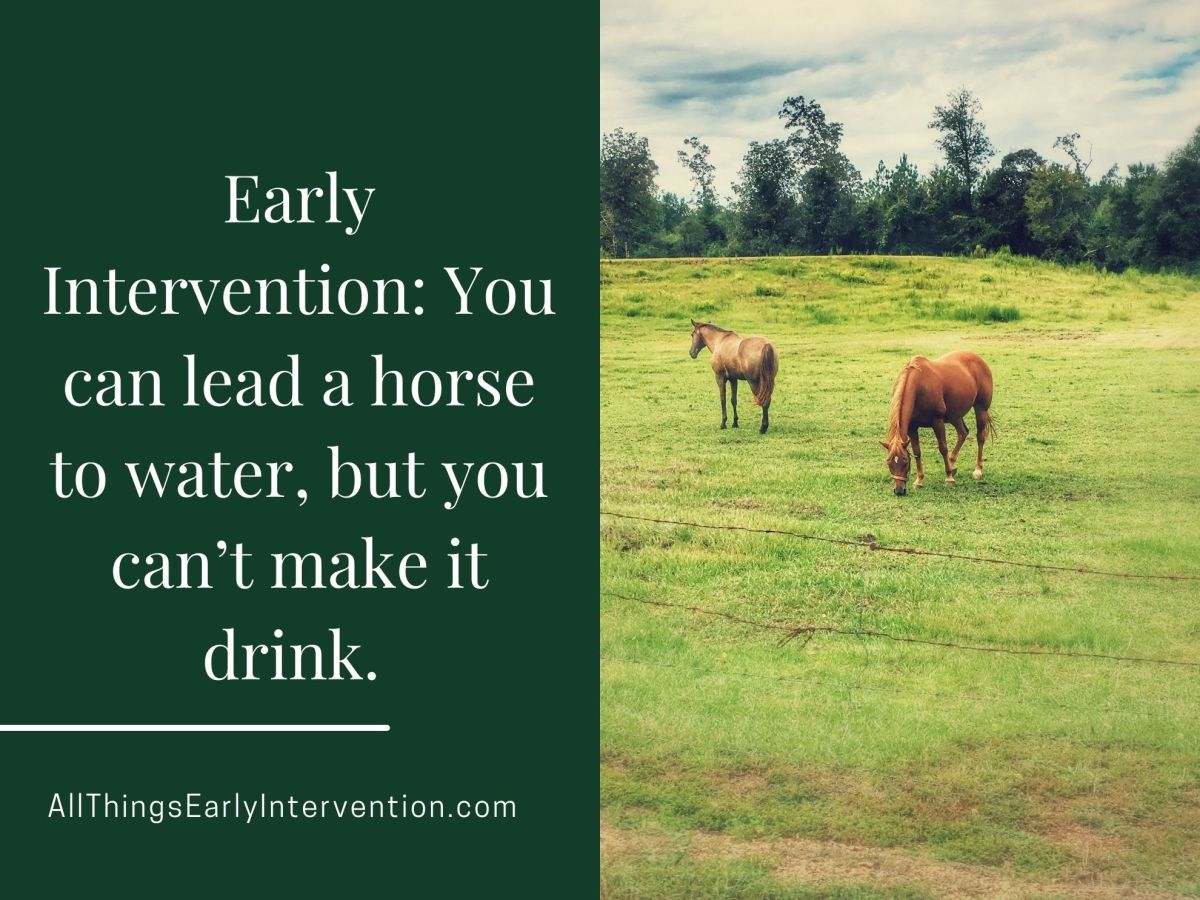
You can lead a horse to water, but you can’t make it drink.
People, like horses, will only do what they have a mind to do.
phrases.org
This phrase describes parenting a toddler very well. Wait. This phrase describes interacting with all humans.
One of the most commonly asked questions I get from parents is, “How do I make my child talk?” Let me just tell you:
You cannot make a child talk.
You cannot make a child do anything.
You can change the environment to make them more likely to do something.
You can reward desired behavior.
Here is what I know to be true.
- You cannot make a child eat.
- You cannot make a child sleep.
- You cannot make a child pee or poop.
- You cannot make a child talk.
Do you know what you can end up making a child do? You can “make” a child cry.
By the way, the answer to teaching your child to talk is play. There are a ton of teaching language strategies, and most of them involve play or assume that you are already good at playing with your child. Unfortunately, this isn’t always the case. Some parents don’t know how to play with their children.
My grandmother used to say, “You can take a horse to water, but you cannot make him drink.” This is true with babies, too.
You can set her on the potty, but you cannot make her pee.
You can put her in her warm and cozy bed, but you cannot make her sleep.
You can serve a nutritious and delicious meal, but you cannot make her eat.
Finally, you can yell and scream, but you cannot make a child talk.
The answer is play!
Here’s another dose of toddler reality. You can buy all the wonderful expensive toys and read all the parenting books, but you cannot make your child play.
Play can be defined as engaging in an activity for enjoyment and recreation rather than a serious or practical purpose. How can you teach a child a skill during an activity that is, by definition, meant for enjoyment rather than serious or practical purposes?
The answer is “guided play.”
“Guided play maintains the joyful child-directed aspects of free play but adds an additional focus on learning goals through light adult scaffolding…As such, it features two crucial elements: child agency (the child directs the learning) and gentle adult guidance to ensure that the child progresses toward the learning goal.”
“The Case of Brain Science and Guided Play: a Developing Story,” by Brenna Hassinger-Das, Kathy Hirsh-Pasek, and Roberta Michnick Golinkoff published in Young Children. May 2017.. Accessed from NAEYC.org April 2024.
As the adult in your child’s life (therapist, parent, or caregiver), you can use playtime with your child as an opportunity to embed your learning goals into the experience. Even if you aren’t deliberately embedding any goals, and you are “just playing,” your child is still having meaningful experiences with objects, people, and activities that reinforce skills. Play is a child’s work. Let them do their work.
 All Things Early Intervention
One reply on “You can lead a horse to water, but you can’t make it drink. Same with babies.”
Thank you for your fantastic insight! This was really helpful!
LikeLiked by 1 person