
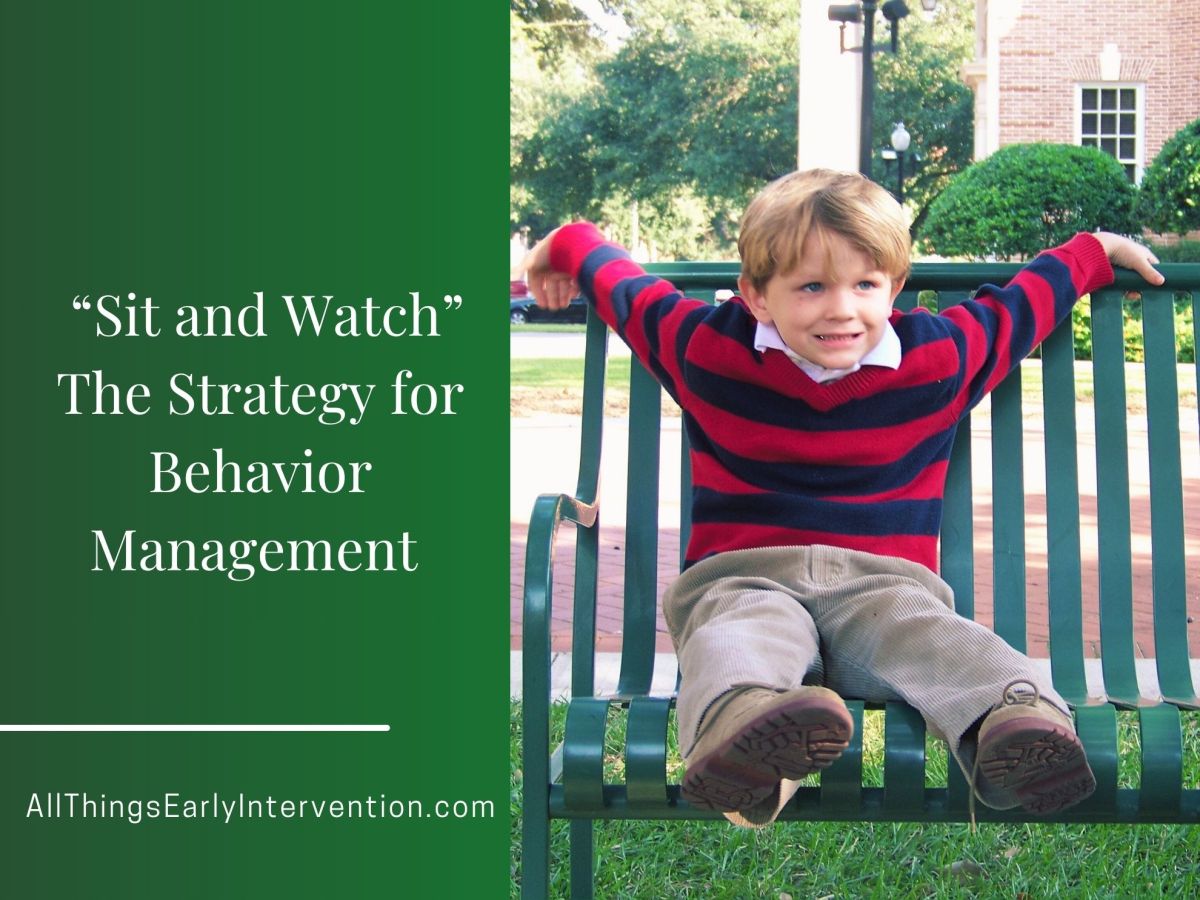
I’ve been fortunate enough to attend several conferences where Dr. Robin McWilliam shared his insights on early intervention and child development. At one session, he discussed a technique called the “Sit and Watch” procedure, designed for preschool settings. The concept immediately resonated with me.
For years, I mentioned this strategy to parents and teachers, but no one seemed to have heard of it. I even started to doubt my own memory because I could barely find any mention of it online. I knew I had heard him talk about it, but without proof, I felt like I was making it up. Thankfully, after some deep diving, I finally found the documentation. It is a real, evidence-based method, and I’m relieved to share it.
When our foster son first came to live with us, he struggled with challenging behaviors like grabbing, climbing, and eating things he shouldn’t. These weren’t acts of defiance; he simply didn’t know better. He was a sweet boy and ready to learn, so we implemented the “Sit and Watch” approach. It was incredibly effective, providing a clear, consistent boundary while teaching him how to rejoin the group appropriately.
Deconstructing “Sit and Watch”
The “Sit and Watch” strategy is a response technique for inappropriate behaviors that focuses on empowering the child. The steps are straightforward:
- Warnings: Give the child two clear verbal warnings about the unacceptable behavior.
- Move the Child: If the behavior continues, gently move the child to the side, away from the activity. Crucially, the child must still be able to see the routine or activity. This is not isolation.
- The Phrase: Tell the child, “When you are ready to play nicely, you can come and play”.
- Welcome Back: As soon as the child decides they are ready, welcome them back without any further fuss.
Two key rules make this work:
- No Time Limit: Unlike traditional time-outs, the child is not forced to stay for a fixed duration. The power is given back to the child to choose when they are ready to return.
- Repetition: If the behavior continues, return the child to the “Sit and Watch” area as many times as necessary.
Sit and Watch vs. Traditional Time-Out
Traditional time-outs often isolate a child in a quiet spot for a set period (like one minute per year of age) as a form of punishment or cooling down. “Sit and Watch” differs because it is not isolation. By staying within visual range, the child maintains the context of the activity and the skills they need to practice. It promotes choice by putting the control of their return entirely in their own hands.
The Value of Sit and Watch in Early Intervention
- It’s a Teaching Tool: It connects a choice (“I am ready to play nicely”) to a natural consequence (rejoining the fun), teaching children to take responsibility for their own behavior.
- It Promotes Intrinsic Motivation: Because the child decides when to return, the motivation to “play nicely” comes from a desire to be part of the group, not from fear of punishment.
- It Supports Prevention: By focusing on the expected behavior, it provides a concrete, rehearsed path toward successful engagement.
Every child is a unique learner, and while “Sit and Watch” is a powerful tool, it’s just one of many we should have in our toolkit. It allows us to treat challenging moments as opportunities to teach and connect.
Have you ever heard of this specific strategy? Have you tried it? I’d love to hear about your results and your thoughts on balancing consistency with a child’s readiness to learn.
References for the Sit and Watch Procedure
Junior League-Vanderbilt Center for Parenting Young Children. (2008, April). The 11 behavior management principles. Vanderbilt University School of Medicine. https://eieio.ua.edu/wp-content/uploads/sites/17/2025/02/misc-behavior_management_principles_english.pdf
This comprehensive guide outlines eleven foundational principles for early childhood behavior, centered on the philosophy that discipline is a teaching process rather than a punishment. It introduces the “Sit and Watch” procedure, a technique where children are moved to the side of an activity but remain in visual range, allowing them to choose when they are ready to return and play appropriately.
McWilliam, R. (n.d.). Ramcwilliam’s website. Retrieved March 28, 2026, from https://sites.ua.edu/ramcwilliam/
This site serves as the professional hub for Dr. Robin McWilliam, a professor of special education and the founder of the Evidence-based International Early Intervention Office (EIEIO). It provides resources on his Routines-Based Model of early intervention, which is implemented globally to support child engagement and family services.
 All Things Early Intervention