
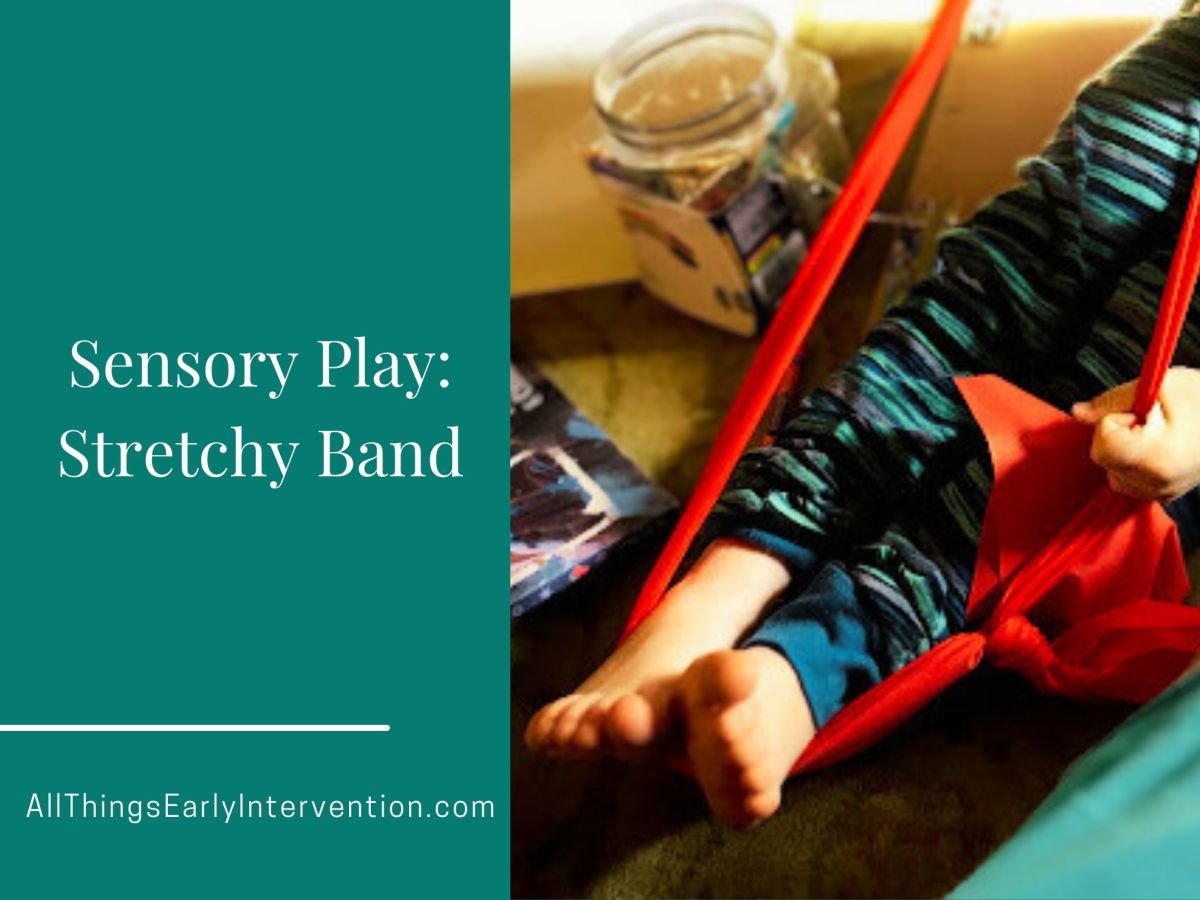
Making Sense of the Stretchy Bands in Early Intervention
For many of us, elastic therapy bands—sometimes known as bouncy bands—are a go-to tool, especially for children who are consistently seeking sensory input.
But as professionals who believe deeply in using evidence-based practice (EBP), we constantly wrestle with what the data actually says versus what we see working in real life. This has been a journey for me.
Elastic Bands in Early Intervention: Is “Worth a Try” Good Enough?
When were parenting our sensory seeking son, —always seeking, always moving, and needing that deep, organizing pressure– we were committed to doing everything we could to meet his sensory needs because we saw with our own eyes that it was helping his behavior. There’s no doubt in my mind it helped.
This is considered “anecdotal.” It’s not scientific. I understand that, but still I’m a believer.
We were told that therapy bands could possibly provide the calming and organizing proprioceptive input he needed. So, we incorporated them throughout the day in moments of play. We offered stretchy bands to him in various forms as a sort of fidget. I realize that even if the activity wasn’t a perfect clinical prescription, it was enjoyable, and he was engaged.
Even though specific, structured stretchy band exercises have not been scientifically proven to benefit children with Autism Spectrum Disorder (ASD) or Sensory Integration (SI) disorders, they are still play activities that are designed to be fun.
While studies don’t show a direct benefit, these do have some proven value in other areas of child development. It is my opinion that if the play activity wouldn’t cause harm, it is therefore worth a try.
When is Fun the Most Valuable Intervention?
When considering the use of sensory tools like elastic bands in our practice, we are essentially navigating two different—but equally important—schools of thought: caution and worth a try.
The Argument for Caution (Bad Science?)
We must first acknowledge the ethical responsibility we have to promote evidence based practice (EBP.) Research, such as that reviewed by the Association for Science in Autism Treatment (ASAT), is critical of structured Sensory Diets. This perspective highlights that the evidence supporting Sensory Diets—often derived from Sensory Integration theory—is currently mixed. As professionals, we are advised to exercise caution and recognize that these interventions should not be used as stand-alone, evidence-based treatments for ASD.
The Argument for Functional Benefit and Fun (Worth a Try?)
On the flip side, we do have data that shows benefits of elastic bands in general. A 6-week resistance study involving 8- and 9-year-olds found that the elastic band exercise program increased the children’s hand grip strength. The study concluded that these bands are an economical and fun way to improve muscular strength in school activity programs. (Özsu, 2018).
Guidance from sources like The OT Toolbox, emphasizes that for the activity to be successful, it must be fun, creative, easy and engaging. This suggests that the bands’ most reliable benefit may be their potential to motivate joyful, functional movement, regardless of a specific diagnosis.
Making Sense of the Bands in Early Intervention
How do we make peace with conflicting information?
For me, I use the bands as a tool for positive replacement behavior.
For a sensory-seeking child who is always looking for movement, if that movement comes in the form of a fun, voluntary activity—like using an elastic band to play with—that is an improvement.
Offering a fun activity as a replacement for negative or disruptive behavior is a principle of behavior support.
The benefits of this particular behavior support might also end up being gains in hand grip strength. That’s ok with me.
What’s Your Balancing Act?
Ultimately, in my experience with our own child the stretchy bands were just one of many small things we tried, and they helped. They provided a quick, acceptable outlet for his movement needs, and he genuinely enjoyed using them.
We can be confident in promoting joyful, developmentally appropriate movement through play. If we can introduce an economical, engaging, and simple activity that children want to do, we are winning.
What about you? What non-EBP tool do you use that you’ve found to be harmless and highly effective in fostering joy and engagement? I’d love to hear your experiences—maybe your example can help someone else.
Some Stretchy Bands on Amazon
As an Amazon Associate I earn from qualifying purchases.
Cooperative Stretchy Band Elastic
BouncyBand Stretch Band Focus Tool
Chair Bands For Kids With Fidgety Feet 3 Pack
References
Association for Science in Autism Treatment. Is there science behind that? Sensory diets. Retrieved from https://asatonline.org/for-parents/becoming-a-savvy-consumer/is-there-science-behind-that-sensory-diets/#:~:text=The%20evidence%20that%20exists%2C%20at,they%20should%20not%20be%20used accessed 10/30/25.
Beck, C. (2018, June 1). Therapy band exercise program for kids. The OT Toolbox. https://www.theottoolbox.com/therapy-band-exercise-program-for-kids/ accessed 10/30/25.
Özsu, I. (2018). Effects of 6-week resistance elastic band exercise on functional performances of 8-9 year-old children. Journal of Education and Training Studies, 6(12a), 23-28. Retrieved from https://eric.ed.gov/?id=EJ1200407 accessed 10/30/25.
 All Things Early Intervention