My experiences
As a classroom teacher of 2 year olds, I dealt with biting often. There were a few times when the biting behavior was a problem enough to have a meeting and develop a plan. We worked as a team and followed the plan. The biting behaviors resolved.
Years later, our own child presented significant behavioral challenges, including biting and hitting. His behavior was closely tied to his developmental delay. This was incredibly stressful. I constantly worried about his safety, the safety of others. We learned strategies that worked. When the strategies were in place, the biting behavior disappeared.
In both of those cases, I came to the conclusion that addressing chronic biting behavior requires 90% adult behavior change and 10% child behavior change. (I just made those numbers up, but you get the idea.)
The Reality of Biting in Childcare
Working with young children in foster care or early intervention often involves navigating challenging behaviors like biting and hitting. The professional stakes are incredibly high: preschoolers are expelled at more than three times the rate of K-12 students, and these children are ten times more likely to drop out of school later in life.
Adults would like it if everything stayed the same in their world, and the child would just learn to “stop biting.”
It is not that simple.
When biting is a problem, the adults need search themselves and what they are doing because the most effective interventions begin with changing the environment to reduce triggers. Biting is frequently a response to environmental stress, boredom, or competition. And that is on us.
Recommended Strategies from Research to Address Biting Behavior in Toddlers
Seek professional help from a pediatrician or child specialist if the biting is vicious, continues beyond age three-and-a-half, or does not decrease after consistent intervention.
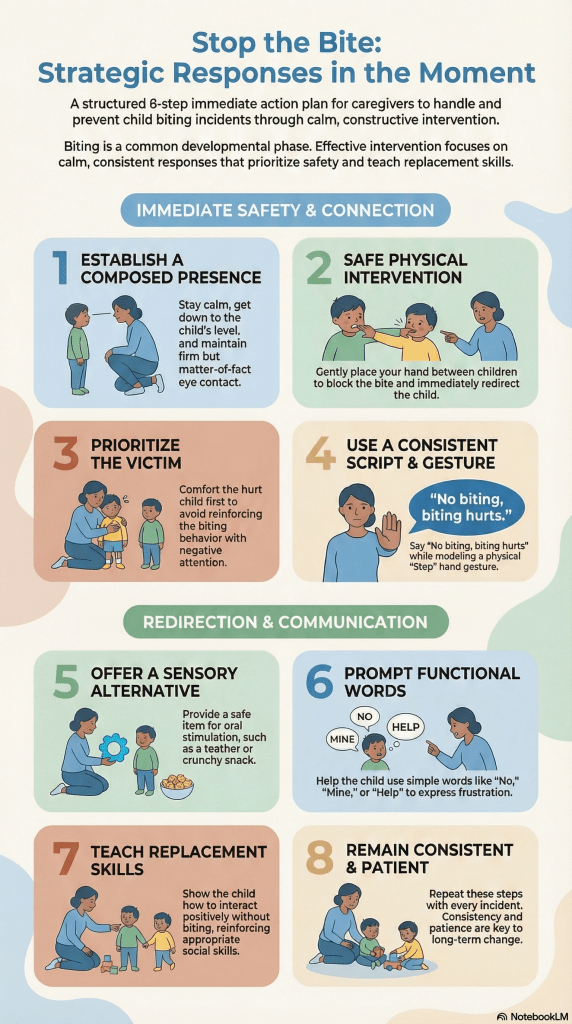
1. Immediate Action in the moment:
- Immediate Verbal Intervention: Prioritize safety and use clear, calm verbal cues like “no biting” or “biting hurts.”
- Prioritize Safety and Empathy: Use calm cues like “biting hurts”. Always attend to the child who was hurt first to avoid reinforcing the act with intense negative attention.
- The Healing Process: Include the child who bit in helping—such as bringing an ice pack—to help them see the concrete results of their actions.
2. Prevention
Prevention Requires Understanding the “Why” of the Behavior. Aggression can stem from various factors, including limited communication skills, frustration, sensory needs, or environmental factors.
- Identify Patterns: Use an ABC log (Antecedent, Behavior, Consequence) to find triggers.
- Shadowing: Assign an adult to stay within arm’s reach during high-risk times to catch a bite before it happens.
- Provide oral motor tools. Offer an abundance of oral motor sensory input tools such as teething toys, vibrating toothbrushes or “chewelery.” These are good options for keeping mouths busy. EVEN IF you think they are “too old” for it.
- Plan “heavy work” sensory activities throughout the day to address any unmet sensory needs.

- Duplicate popular toys to reduce competition so toddlers aren’t forced into “sharing” for which they aren’t ready or very good at.
Teeth Are Not for Biting download is available at Social workers toolbox.com
https://pdfcoffee.com/teeth-are-not-for-biting-pdf-free.html
3. Teaching Prosocial Behaviors:
- Educate the Whole Class: Make Teeth Are Not For Biting a circle time book to teach appropriate alternatives to biting. Strategies mentioned in the book include:
- Chew a chewy toy
- Drink a cold drink
- Take a little rest
- Get a hug
- Use your words
- Tell a grown up
- Take a little break
- Follow Through: Make sure if you are teaching children to “drink a cold drink” or “chew a chewy toy” or “get a hug” as an alternative to biting, you need to make sure drink and chewy toys and hugs are available when requested.
- Teach Self-soothing and deep breathing. Here’s my favorite version of this. Daniel Tiger.
- The Language of Emotions: Even children with an age appropriate language development benefit from ongoing instruction on using their language to talk through conflicts and emotions. This is referred to as emotional literacy.
- Social Stories or Social Scripts might be the solution for you. Read about my drive thru social story here.
- Class-Wide Protection: Empower the whole class by teaching a physical “stop” hand gesture paired with the words, “Stop, that hurts,” so every child has a tool for self-defense.
- Classroom-wide Curriculum: The sources describe a “Book Nook” approach (specifically for a similar title, No Biting! by Karen Katz) that provides a template for how a single book can be expanded.
- Interactive Emotional Literacy: Beyond circle time, use “Feeling Wheels” to help children match actions in the book to emotions like anger or frustration.
- Interactive Learning: Provide props (like a plastic apple or a pillow) and have children point to what is “okay” to bite (apples, crackers, teething toys) versus what is not.
- Dramatic Play: Practice “feeding” dolls to show that teeth are for food.
An Overall Culture Change
A critical part of adult change is reframing how we perceive the child. We must avoid the “biter” label, which can intensify the behavior, and instead recognize biting as a developmentally appropriate form of communication for those lacking verbal skills.
Normalizing the Conversation: Educating the whole class by placing the books in the classroom library makes the topic a regular part of the learning environment rather than a “taboo” or reactive one.
Success requires absolute consistency among all caregivers. We must avoid harmful practices like “biting back” and move toward intentional teaching to ensure every child is supported rather than pushed out. The harder we work to meet these needs, the sweeter the reward for the entire class.
2-week Road Map to Address Biting Behavior
While Elizabeth Verdick’s Teeth Are Not for Biting is a foundational tool, a true whole-classroom intervention uses the book as an anchor for active learning.
This overview provides a 2-week roadmap for focusing on adding one thing at a time to avoid being overwhelmed. You do not have to do them in order or at this pace. Some people find an slow paced step by step guide to be helpful.
- Day 1: The Immediate Response Plan. Stay calm and use a firm, matter-of-fact tone to say, “No biting. Biting hurts”. Always attend to the victim first to avoid reinforcing the biting behavior with intense adult attention.
- Day 2: Start an ABC Observation Log. Track every biting incident or near-miss by recording the Antecedent (what happened before), Behavior, and Consequence (how you reacted).
- Day 3: Start the Conversation: Read Elizabeth Verdick’s “Teeth Are Not for Biting” together with your child. Make reading and talking about this book a daily and pleasant experience.
- Day 4: Check your Resources. If biting occurs over toys, duplicate favorite items so the child isn’t forced to share before they are developmentally ready. Remove high-conflict toys temporarily if necessary.
- Day 5: Provide “heavy work” activities: such as pushing a stroller, pulling a wagon, jumping, or hitting a toy drum to help children regulate their bodies and release tension throughout the day.
- Day 6: Oral Motor Sensory Support. Provide several activities for oral motor exploration with safe items such as teethers or vibrating toothbrushes.
- Day 7: “Crunchy Snack” activity. Offer apples, crackers, or pretzels, and narrate the experience: “We are using our teeth for biting food.” Make a plan to incorporate crunchy snacks at regular intervals throughout the day moving forward.
- Day 8: Interactive Reading. Read Karen Katz’s “No Biting!”. Have children point to the pictures of what is “okay” to bite vs. what is not.
- Day 9: Shadowing. Identify “high-risk” times from your ABC log and stay within arm’s reach of your child during these windows to intervene before a bite happens.
- Day 10: Take a Deep Breath and Let it Go: Teach Deep Breathing for relaxation with Daniel Tiger’s Give a Squeeze Song. Set up a “Cozy Corner” with pillows and soft books and encourage your child to go to the cozy corner when she needs a break.
- Day 11: Teaching “Stop”. Teach your child and playmates to use the physical “stop” hand gesture paired with the words, “Stop, that hurts.” Practice this through role-play so they have a tool to protect their personal space. You will teach your child BOTH how to listen when someone else tells them to stop and how to tell someone else to stop.
- Day 12: The Feeling Wheel. Introduce the vocabulary of basic emotions like “mad” or “sad” with a feeling wheel. Use it while reading books or role play to help your child identify what a character might be feeling when they want to bite.
- Day 13: Practice Empathy Building. Role play what to do if someone gets hurt. Teach children how to bring an ice pack, a bandage, or a comfort item to a someone who gets hurt.
- Day 14: Review and Consistency. Ensure all caregivers (partners, grandparents, babysitters) are using the exact same language and strategies. Review your ABC log to see if incidents have decreased and adjust environmental supports as needed.
References for Dealing with Biting
| Reference | Description |
|---|---|
| A bite in the playroom: Managing human bites in child care settings. (2008). Paediatrics & child health, 13(6), 515–526. | This clinical report provides guidance for childcare providers and healthcare workers on managing human biting incidents among young children. |
| Better Kid Care. (2025, May 12). Positive guidance: A pathway to reduce biting behavior. Pennsylvania State University. | Outlines five core strategies for educators to reduce biting using responsive guidance rather than reactive punishment. |
| Brogle, B., Jiron, A., & Giacomini, J. (n.d.). How to help your child stop biting. Backpack Connection Series. National Center for Pyramid Model Innovations. | A family-oriented handout explaining the “why” behind biting and providing practical “Try This at Home” and “Practice at School” tips. |
| CELA. (2023, August 1). Strategies for addressing biting in early education services. | Explores biting as a form of communication for toddlers and offers multifaceted strategies including oral sensory alternatives and biting policies. |
| Center for Community Inclusion and Disability Studies. (2024, July 25). OUCH! That hurts! — Biting – Selected resources. University of Maine. | A curated list of books, articles, and training modules designed to help parents and staff manage biting behaviors. |
| Center on the Social and Emotional Foundations for Early Learning. (n.d.). Responding to your child’s bite. Vanderbilt University. | A parenting tool that categorizes the reasons children bite and provides step-by-step guidance for “in the moment” responses. |
| Child Australia. (2012). When children bite! A resource for early childhood educators. | A detailed professional resource covering child development, environmental triggers, and service-wide approaches to biting. |
| Dunlap, G., & Duda, M. (n.d.). Using functional communication training to replace challenging behavior. What Works Briefs, No. 11. Center on the Social and Emotional Foundations for Early Learning. | Focuses on Functional Communication Training (FCT) as a strategy to replace aggressive behaviors like biting with appropriate verbal or visual communication. |
| Einhorn, E. (2019, August 3). Kicking kids out of preschool is damaging, experts say. So why is it still happening? NBC News. | A journalistic report highlighting the negative impacts of preschool expulsion and the need for better teacher training and mental health support. |
| National Resource Center for Health and Safety in Child Care and Early Education. (n.d.). Handling Physical Aggression, Biting, and Hitting from Caring for Our Children (CFOC). https://nrckids.org/CFOC/Database/2.2.0.7 | Literally the “How to” guide for childcare centers on best practices. |
| Lentini, R., Vaughn, B. J., Fox, L., Blair, K. S., Winneker, A., von der Embse, M., Binder, D. P., & National Center for Pyramid Model Innovations. (2025, June 16). Teaching tools for young children: Using function-informed support to address challenging behavior within routines (4th ed.). National Center for Pyramid Model Innovations. | A comprehensive manual providing step-by-step strategies to prevent, teach, and respond to challenging behaviors within specific classroom routines. |
| Mondi, C. F., Rihal, T. K., Magro, S. W., Kerber, S., & Elizabeth A. Carlson. (2022). Childcare providers’ views of challenging child behaviors, suspension, and expulsion: A qualitative analysis. Infant Mental Health Journal, 43(5), 695–713. | A qualitative study examining the experiences and decision-making processes of childcare providers in Minnesota regarding suspension and expulsion. |
| National Association for the Education of Young Children. (n.d.). Understanding and responding to children who bite. | Provides families with insights into why children bite and offers strategies for both immediate response and long-term prevention. |
| Neitzel, J. (2008). Steps for implementation: PMII for early childhood. The National Professional Development Center on ASD, Frank Porter Graham Child Development Institute, The University of North Carolina. | Outlines a 5-step process for implementing Peer-Mediated Instruction and Intervention (PMII) to support social skills in early childhood. |
| North Carolina Child Care Health Consultants. (2026). Biting in child care. NC Resource Center. | A quick-reference guide for early educators on identifying triggers, teaching social skills, and building calm, predictable environments. |
| Ramming, P., Kyger, C. S., & Thompson, S. D. (2006, January). A new bit on toddler biting: The influence of food, oral motor development, and sensory activities. YC Young Children, 61(2). | Discusses developmental reasons for biting, specifically focusing on oral motor development and the use of sensory activities as a deterrent. |
| Solomons, H. C., & Elardo, R. (1991, July-August). Biting in day care centers: incidence, prevention, and intervention. Journal of Pediatric Health Care, 5(4), 191-196. | Analyzes biting patterns in daycare centers and suggests physical room changes and classroom management techniques to reduce incidents. |
| Williams, G., & Yogman, M. (2023, October 30). Preventing preschool expulsions: AAP policy explained. HealthyChildren.org. | Explains the American Academy of Pediatrics’ stance against expulsion and provides guidance for parents on navigating behavior challenges collaboratively. |
| Williams, P. G., Yogman, M., Council on Early Childhood, & Committee on Psychosocial Aspects of Child and Family Health. (2023, November). Addressing early education and child care expulsion. Pediatrics, 152(5), e2023064049. | A professional policy statement detailing the systemic disparities in preschool expulsion and the critical role of pediatricians in prevention. |
| Wimmer, A., & Lentini, R. (n.d.). Book Nook: No Biting! Center on the Social and Emotional Foundations for Early Learning. | Provides activities and teaching tools (like Feeling Wheels and Puppet Books) to use Karen Katz’s book No Biting! as a social-emotional curriculum. |
| ZERO TO THREE. (2025, February 22). Toddler biting: Finding the right response. | Offers detailed strategies for prevention, including distraction, shared resource management, and emotional literacy support. |
 All Things Early Intervention