
This blog post is part of a series Rules for Early Intervention Home Visiting and you can read about them here.
Keeping Your Opinions to Yourself: A Guide for Early Intervention Providers
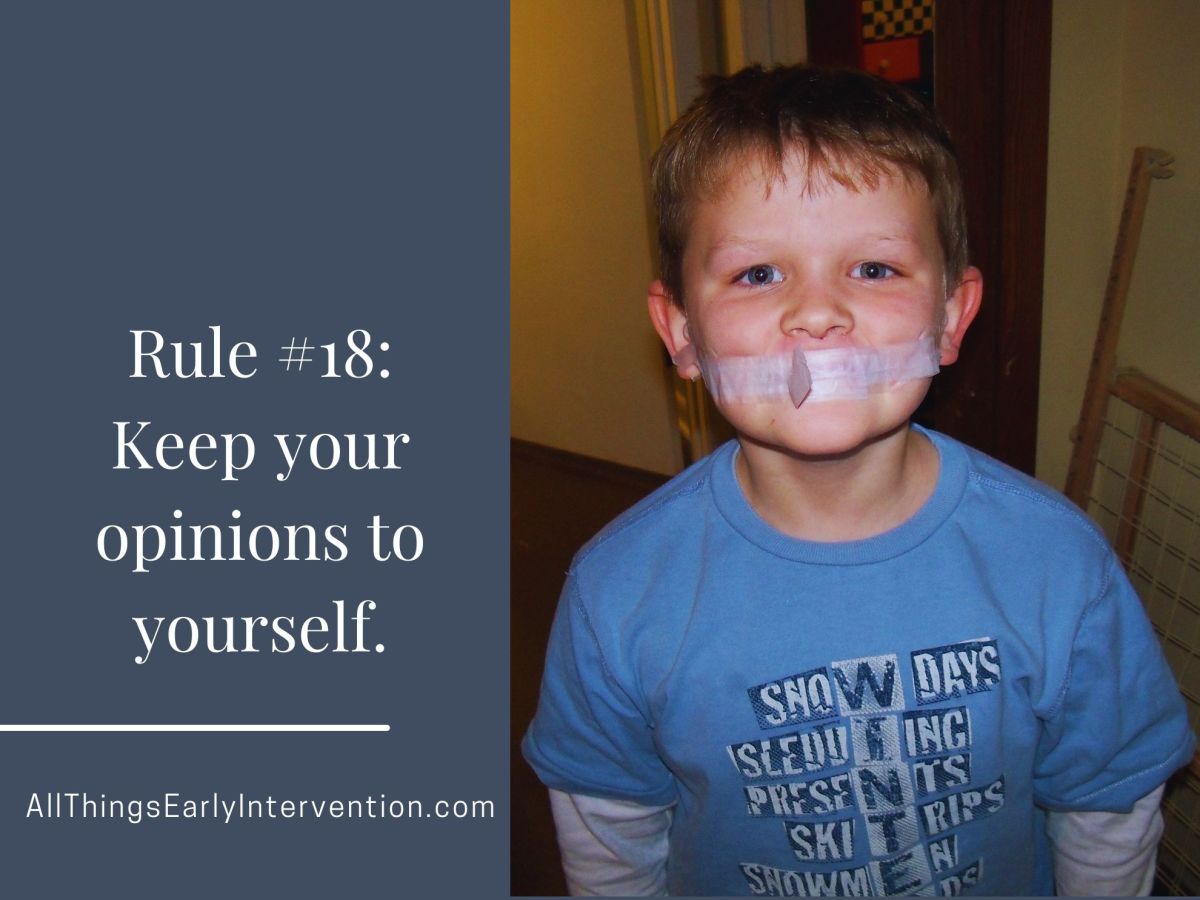
Hey fellow providers, let’s talk about something we all have. Your opinion. Specifically sharing those opinions with families. We’re passionate, we’re knowledgeable, and we genuinely want the best for these kids. But when it comes to the “hot topics” such as breastfeeding, discipline, sleeping to name a few….we are not tasked with offering our opinion, we are tasked with offering information to let parents make their own decisions.
The Art of Keeping Your Opinions to Yourself
1. Food Choices= Hot Topic
Family culture plays a role in decision-making when it comes to child-rearing. If the client you are talking to was raised on Kool-Aid and Vienna sausage, then when you share your opinion that feeding babies Vienna sausage is disgusting, that can be interpreted as talking bad about their mama.
“What’s more, parents tend to hold fierce opinions when it comes to their children’s health, explains Liane Young, a professor of psychology and neuroscience at Boston College who specializes in moral judgment. If you strongly identify with a particular set of traits, “anything that departs from what you do can feel like your decisions are being undermined or your identity is being threatened,” she says.”
“Judging what others feed their kids is a blood sport. Why?” by Rina Raphael, March 14, 2023, LA Times.
Parents are walking a tightrope. They’re juggling sleep deprivation, conflicting advice from well-meaning relatives, and the overwhelming pressure to “get it right.” The last thing they need is another voice weighing in with their two cents.
2. Remember Who You Are: A Professional
We’re not just anyone; we’re professionals. Our job is grounded in evidence-based practices, professional association standards, and recommendations. Most of the time our personal opinion aligns with our professional opinion, but not always. Be aware of where your opinions fall and be careful you are not pushing your own agenda.
3. When Opinions Matter: Professional Judgment vs. Personal Preference
Now, this doesn’t mean we never offer our input. Professional judgment is key. If a parent’s choices are:
- Potentially harmful: For example, if a parent refuses to use a car seat, we have an obligation to address this.
- Interfering with therapy: If a parent’s approach is directly hindering the child’s progress, we need to find a way to address it.
4. Navigating the Gray Areas
Let’s be honest, most of it falls into the gray area. Here’s how to approach it:
As long as families are being safe and not abusive or breaking the law it is not your place to force your opinion on clients.
Share best practices.
Share research.
Share strategies that align with the above.
Keep your opinion to yourself as much as possible.
5. Spanking=Another Hot Topic
“Home visitors must walk a delicate line as they develop a relationship with parents based on respect, including respect for a family’s cultural beliefs, while sharing information on harsh punishment. “
Home Visitor Supervisor’s Handbook, “Ethical Considerations for Home Visiting” Headstart.gov September 15, 2022.
How to Offer Suggestions (Professionally):
Instead of making it personal, try the following:
- Offer alternative strategies from reputable organizations without criticizing the family’s choices You can then be in the role of informing families on what the professionals recommend.
- Respectful disagreement: If a family disagrees with your proposed strategy, acknowledge their viewpoint and emphasize that your role is to offer options based on best practices. Then let it go. As a professional, you don’t need to engage in “healthy debate” with a parent. That’s not going to end well.
Remember, our goal is to empower families, not to dictate their parenting choices.
What strategies have you found successful when navigating sensitive topics with families? Share your experiences in the comments below! Let’s continue to learn and support each other in this collaborative journey.
 All Things Early Intervention