
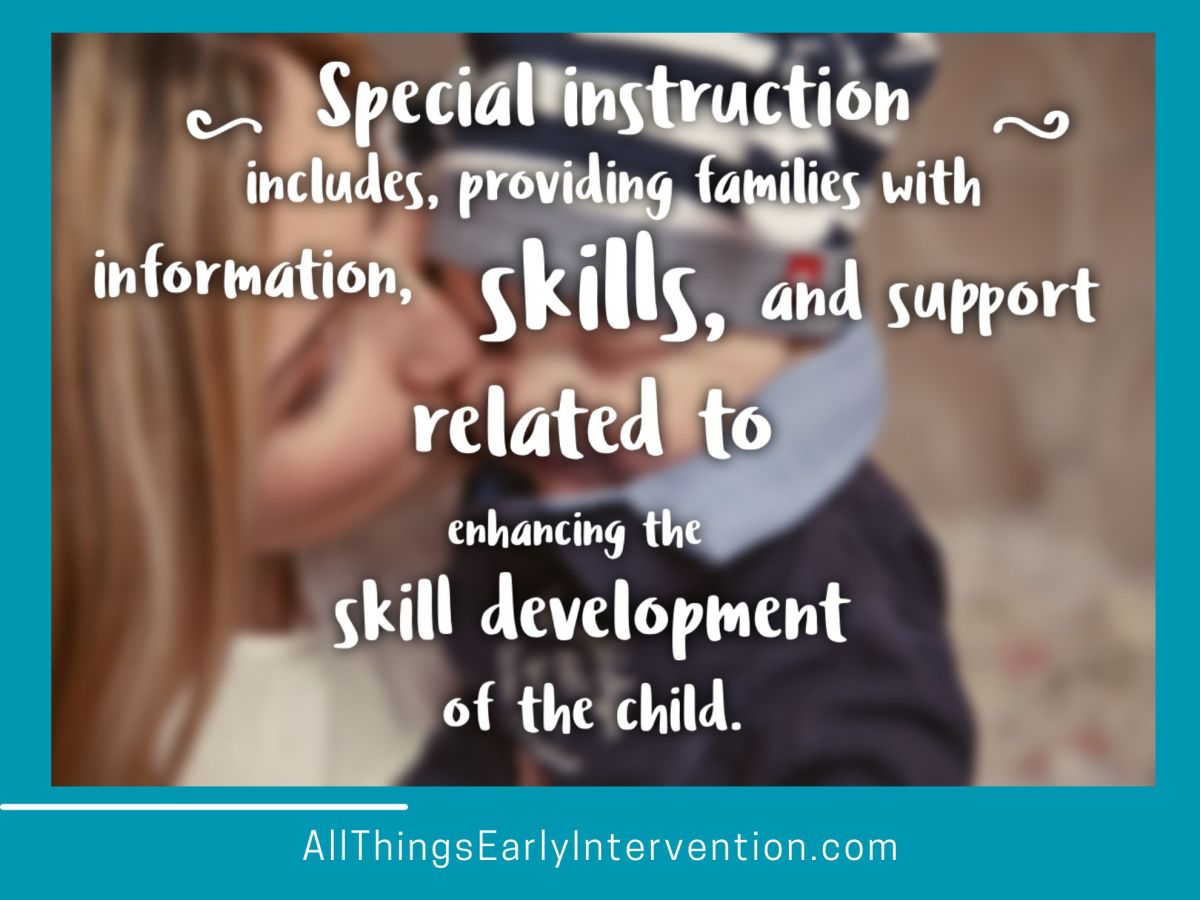
Providing families with information, skills, and support.
This is the third in a four-part series exploring “What is Special Instruction?”

What Is Special Instruction?
This is a four part series diving into the answer to that question using the Division of Early Childhood Position Statement as a reference.
The Division of Early Childhood has this to say in the position statement “The Role of Special Instruction in Early Intervention.” Special Instruction includes:
The designing of learning environments and activities that promote the child’s acquisition of skills in a variety of developmental areas, including cognitive processes and social interactions,
Curriculum planning, including the planned interaction of personnel, materials, and time and space, that leads to achieving outcomes in the child’s individualized family service plan,
Providing families with information, skills, and support related to enhancing the skill development of the child; and
Working with the child to enhance the child’s development
Special Instruction is an Early Intervention Service that provides families with information, skills, and support to help their child’s development
Let’s explore the part of special instruction that includes “providing families with information, skills, and support related to enhancing the skill development of the child.”
Each family I meet is different, but each is the same. These families may have different ways of going about it, but each family that has willingly entered our voluntary Early Intervention program has one thing in common. They all care very deeply about their children.
They want what is best. They want to do what they think is best.
Everyone (including each Early Intervention parent) is doing the best they can with what they’ve got in that moment.
Now, what we professionals think is best may not always be the same as what the family thinks. As therapists, what is important to us may not be in line 100% with what is important to them.
However, one of our jobs as Special Instructors is still to provide families with information, skills, and support. Notice it did not say manipulation and guilt. We are called to provide information, skills, and support to enhance their child’s skill development.
Special Instructors Provide Families with Information
This may be broad. Giving the mom information on how to apply for disability income indirectly serves to enhance the skill development of her child. If the mom has the money to pay for gas for doctor appointments, the child will have medical care, and his development will be enhanced. Supporting moms searching for quality childcare will enhance the child’s skill development. And so on and so forth.
Information I provide to my families sometimes comes in the form of handouts related to the developmental milestones we are working on. It might include handouts related to their child’s diagnosis too. It depends on the family’s “thirst” for knowledge about how much I give them.
Special Instructors Provide Families with Skills
So many little skills may come naturally to some parents but may not, such as how to increase tummy time while decreasing crying time. Other things include language-stimulating activities, how to use parentese, how to provide the right sensory stimulation, or how to read distress cues in their child.
Special Instructors Provide Families with Support
Support looks like being there to talk about stressors, offering encouragement, or maybe just listening to what is going on with their child. These families are often going through difficult experiences related to their child’s health, and they need someone to listen who understands what they are going through.
What are other ways that you provide information, skills, and support to your parents?
Three Principles to Improve Outcomes for Children and Families from the Center on the Developing Child at Harvard University
When we sit on a living room floor and coach a parent on how to engage in “serve and return” play, we are supporting responsive relationships. When we help a family establish routines or break down big developmental goals into small, manageable steps, we are strengthening core skills. And perhaps most importantly, by being…
Keep reading
Down Syndrome Resources
My intent is to add more as I go. Do you have any other resources for Down Syndrome you’d like me to add? Are you blogging about your child with Down Syndrome? Let me know in the comments.
Keep reading
Health Information Resources in Early Intervention: Children’s Hospitals
We are not expected to be medical doctors, but we are expected to be informed team members. Utilizing these health libraries ensures our practice—and our resource sharing—is grounded in reliable information.
Keep reading
Find Your Professional Association in Early Intervention
If you are currently working in early intervention, I urge you to join your dedicated professional organization today. It’s not just an expense; it’s an investment in your professional competence and longevity, helping you continuously build your value and ensure your knowledge remains up to date.
Keep reading
Wright’s Law and Wrightslaw: Empowering Early Intervention Advocacy
The core principle of Wright’s Law is that parents have the right to be involved in their child’s education and advocate for their needs.
Keep reading
Using the CDC as a Trusted Resource for Early Intervention
Remember, knowledge is power, and the CDC is a fantastic resource for anyone invested in the healthy development of all children.
Keep reading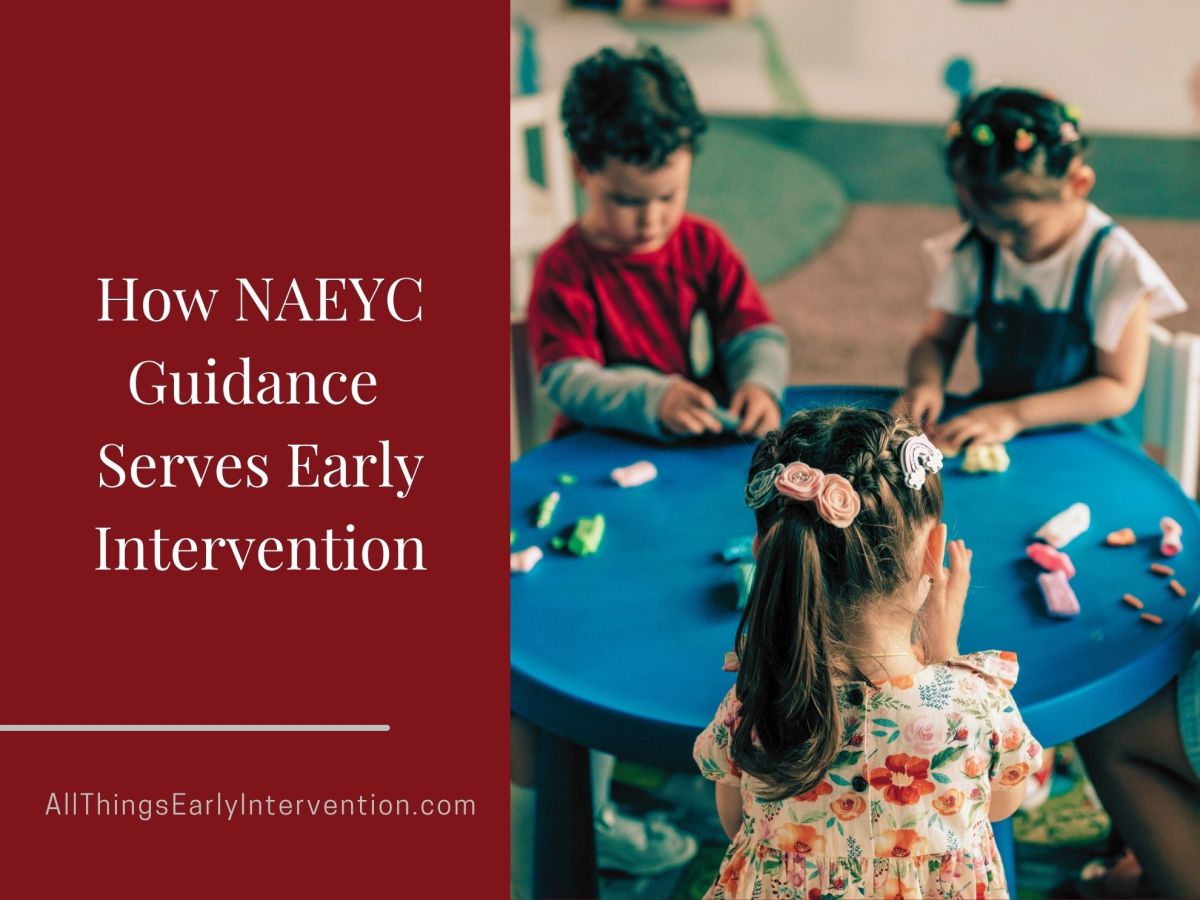
How NAEYC Guidance Serves Early Intervention
NAEYC’s commitment to high-quality early childhood education makes them a valuable asset for both early intervention professionals and the families we serve. By working together with organizations like the NAEYC, we can ensure all children have the opportunity to thrive.
Keep reading
Using Pathways.org Videos in Early Intervention
The parents’ faces lit up! Seeing the skill in action made the milestone tangible and understandable. It wasn’t just words anymore; it was a real-life demonstration. I find these videos incredibly helpful, not only for showcasing current skills but also for providing a visual preview of what to expect next.
Keep reading
Using Non-Profits as Sources of Information in Early Intervention
Non-profit organizations can be a source of support for families with special needs. Teach familiar how to evaluate a site’s trustworthiness so that they can make informed decisions. Remind parents that they are their child’s best advocate, and critical thinking is their most powerful tool.
Keep reading
All Things Early Intervention: Blending Personal Experience with Research
What do you base your professional knowledge on? For me and this blog, I’m committed to everything I share coming from a blend two types of resources—personal stories and credible sources—to ensure every post is both genuine and supported by evidence.
Keep reading
The American Academy of Pediatrics: A Trusted Resource for Early Intervention
We’re not here to give medical advice. We’re here to give parents the tools to seek the best medical advice.
Keep reading
What Is Toy Safety?
The Consumer Product Safety Commission (CPSC) is the US Government agency that plays a crucial role in ensuring the safety of toys for children. They are responsible for regulating consumer products and protecting the public from unreasonable risks of injury or death.
Keep reading
